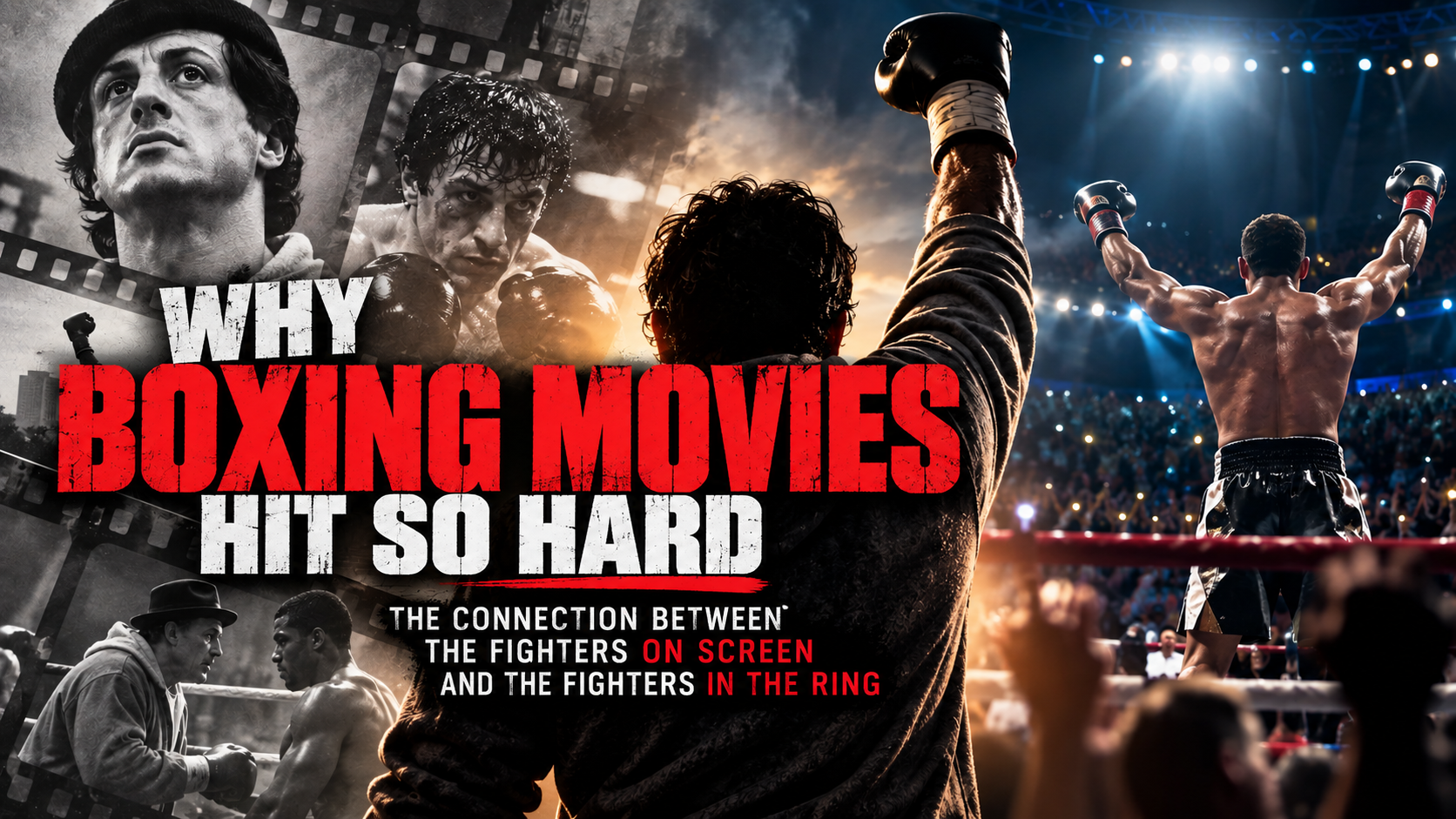
Plenty of sports have made the jump from stadium to cinema, but few have formed a relationship with the big screen like boxing.
Football movies can be exciting. Baseball has inspired some beautiful films. Motorsport has speed, danger, and spectacle built in. Yet boxing seems almost designed for cinema.
Two people. One ring. Nowhere to hide.
Perhaps that simplicity explains why filmmakers have returned to boxing for generations. But it doesn’t fully explain why audiences become so emotionally attached to the people wearing the gloves.
The greatest boxing films aren't really about punching somebody in the face. They're about what happens before the bell rings — and what remains after it stops.
THE FIGHT IS ONLY PART OF THE STORY
We rarely fall in love with a boxing movie because of the boxing
Think about Rocky.
The lasting image might be Rocky Balboa standing in a boxing ring, but the film became such a phenomenon not simply because audiences wanted to know whether Rocky could beat Apollo Creed.
They cared about Rocky.
They saw the tiny apartment, the lonely streets of Philadelphia, the awkward relationship with Adrian and a fighter who had reached a point in his life where he desperately needed to prove something — not necessarily to the world, but to himself.
By the time Rocky steps through the ropes, the audience has already fought alongside him.
That’s the secret.
A great boxing movie makes the final fight matter long before the first punch.
And real boxing can work in exactly the same way.
WHEN THE STORY IS REAL
Knowing what a fighter sacrificed changes the way we watch
Watch a boxing match knowing absolutely nothing about either fighter, and it can still be entertaining.
But learn their stories first, and suddenly every round feels different.
Maybe one fighter has spent years working through small venues waiting for an opportunity. Perhaps they've suffered a devastating defeat and are attempting to rebuild their career. Maybe they're an ageing former champion being told their best years are behind them.
Then there is the undefeated prospect carrying enormous expectations, the journeyman who receives the phone call nobody expected, or the challenger travelling into another fighter's hometown knowing almost everyone in the arena wants them to lose.
Those aren't movie scripts.
They happen in boxing all the time.
It means the audience isn't simply watching punches land. They're watching somebody's ambition, reputation, and sometimes entire career being tested in real time.
Cinema recreates that tension.
Boxing actually lives it.
ROCKY UNDERSTOOD SOMETHING IMPORTANT
Winning isn't always the point
One of the smartest decisions in Rocky is also why the movie remains so powerful decades later.
Rocky doesn't need to win.
His personal victory is surviving.
He wants to know that when the final bell rings, he will still be standing.
It completely changes what the audience considers a victory, and it's remarkably close to the way real boxing stories can develop.
A fighter can officially lose and still leave the ring with a transformed reputation.
An underdog can take a world champion further than anybody expected. A young fighter can suffer their first defeat and ultimately become better because of it. A veteran can produce one final performance that reminds everyone why they became champion in the first place.
Boxing records are brutally simple: wins, losses and draws.
The stories behind those numbers aren't.
FROM RAGING BULL TO CREED
Boxing gives filmmakers something other sports struggle to replicate
Martin Scorsese’s Raging Bull approached boxing very differently from Rocky. The ring wasn’t simply somewhere Jake LaMotta fought opponents. It became an extension of his personality, anger and self-destruction.
Years later, The Fighter explored family, addiction, loyalty and the enormous pressure surrounding Micky Ward’s career.
Million Dollar Baby used boxing to explore ambition and human connection.
Then Creed took one of cinema’s most recognisable boxing franchises and made it personal again. Adonis Creed wasn’t merely trying to become a fighter. He was wrestling with the legacy of a father he never really knew.
Different films. Different characters. Different eras.
But the same fundamental idea remains underneath them.
The opponent standing across the ring isn’t always the biggest fight.
THE PERFECT CINEMATIC SPORT
Boxing strips everything down to two people
A boxing ring has something visually powerful about it.
The ropes create a boundary. The crowd disappears into darkness. The lights focus attention on two people standing only feet apart.
No teammates can take responsibility.
When something goes wrong, everybody sees it.
A fighter can receive instructions from their corner between rounds, but when the bell sounds, they have to walk back out alone.
For filmmakers, that is an extraordinary storytelling device.
A boxing match already has structure.
There is a countdown. There are rounds. Momentum changes. Exhaustion becomes visible. Injuries accumulate. One punch can reverse everything that happened during the previous 20 minutes.
Cinema doesn't have to invent the drama.
It simply has to capture it.
WHY REAL BOXING CAN FEEL LIKE A MOVIE
The sport constantly creates stories nobody could confidently script
Another reason boxing movies and real boxing fit together so naturally is unpredictability.
In a fictional film, someone behind the camera already knows how the fight ends.
In real boxing, nobody does.
That’s an extraordinary difference.
Thousands of people can enter an arena believing they know exactly what’s about to happen. Commentators can analyse styles. Journalists can study previous fights. Trainers can spend months preparing a game plan.
Then one punch changes everything.
The heavily favoured fighter suddenly looks vulnerable.
The challenger nobody expected to survive the opening rounds is still standing in the tenth.
A fighter who appears exhausted discovers another burst of energy.
That uncertainty produces the kind of moments Hollywood spends millions trying to manufacture.
Boxing gets them for real.
WE DON'T JUST FOLLOW CHAMPIONS
Fans become invested in journeys
This is perhaps where the connection becomes strongest.
Boxing fans don’t simply watch individual fights. They follow careers.
They remember when a fighter was appearing on an undercard before most people knew their name. They remember the first difficult test, the first defeat, the comeback and eventually the title opportunity.
Over time, the audience builds a relationship with that journey.
Cinema compresses the same experience into two hours.
We meet the fighter. We understand what they want. We see what stands in their way. We watch them train, fail, get hurt, and keep going.
Then the bell rings.
That’s why the training montage has become such an iconic part of boxing cinema. It isn’t merely showing somebody getting fitter. It’s showing transformation.
Every mile run and every punch thrown tells us that the character is moving closer to the moment when there will be nowhere left to hide.
THE WALK TO THE RING
Few sports understand anticipation quite like boxing
Something unique also happens in the minutes immediately before a fight.
The dressing room.
The gloves being taped.
The final words from the trainer.
The music beginning.
Then the walk.
A fighter can spend months preparing for a contest, yet everything eventually narrows to a few minutes as they make their way toward the ring.
Movies understand the power of that moment because anticipation is one of cinema’s greatest tools.
The audience knows something important is about to happen.
Boxing fans feel the same way watching the real thing.
Sometimes the ring walk can feel almost as important as the opening bell because it's the moment when preparation ends, and reality begins.
There is no more training.
No more predictions.
No more talking.
It's time.
THE PERSON BEHIND THE GLOVES
Boxing works best when we understand who is fighting
Perhaps that is why boxing journalism matters, too.
Results tell us what happened.
Stories tell us why we should care.
Following fighters, trainers, rivalries, title negotiations and the events surrounding the sport creates context. When fight night eventually arrives, you're no longer watching two strangers exchanging punches.
You understand what's at stake.
That's something we're exploring more through our coverage at Boxing Ring News, where the focus goes beyond results to the fighters and stories shaping the sport.
The closer you follow boxing, the more obvious its connection to cinema becomes.
The characters are already there.
So are the rivalries.
So are the setbacks, comebacks, villains, heroes, shock endings and moments of triumph.
The only difference is that nobody has written the ending.
WHY WE KEEP COMING BACK
Every fighter enters the ring carrying a story
Maybe that's ultimately why boxing movies affect people so deeply.
Most of us will never challenge for a world championship.
Most of us will never walk into Madison Square Garden or Wembley Stadium with thousands of people screaming our name.
But almost everyone understands what it feels like to struggle with something.
We understand fear.
We understand failure.
We understand wanting another chance.
We understand being knocked backwards by life and deciding whether we’re going to stay there.
Boxing turns those feelings into something physical.
A fighter gets knocked down.
The referee begins counting.
And they have to decide whether to stand up.
Cinema has used that image countless times because almost everybody understands what it means without explanation.
It’s bigger than boxing.
It’s resilience made visible.
That is why fictional fighters like Rocky Balboa can feel strangely real, and why real fighters can sometimes appear larger than any character Hollywood could invent.
A great boxing movie makes us forget we’re watching actors.
A great boxing match makes us forget there was ever a script.
And somewhere between those two worlds lies the reason we’ve never stopped watching.
““A great boxing movie makes us forget we’re watching actors. A great boxing match makes us forget there was ever a script.””